
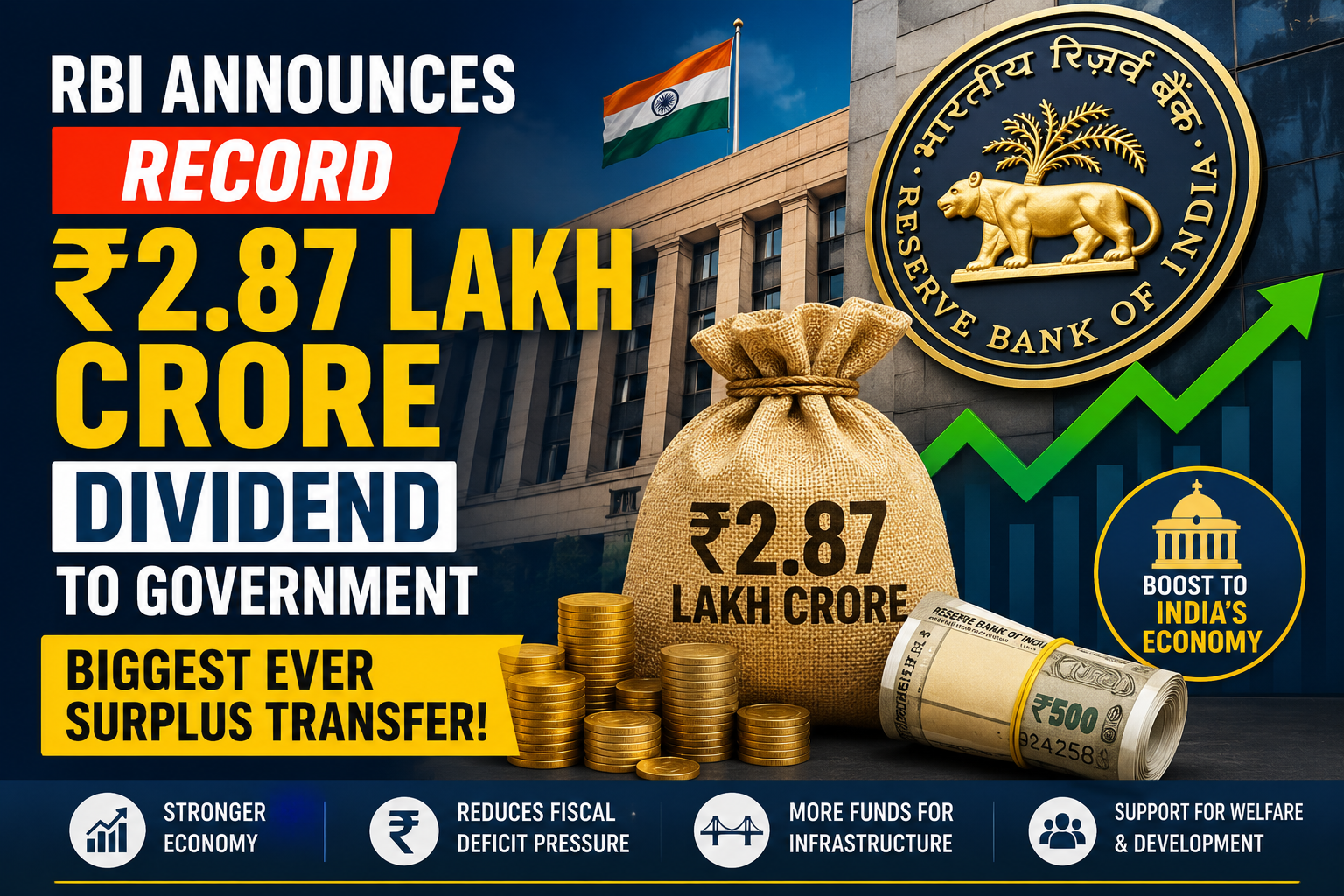
RBI Announces Record ₹2.87 Lakh Crore Dividend to Government; Biggest Ever Surplus Transfer
Published: May 26, 2026
Category: RBI News / Indian Economy
The Reserve Bank of India (RBI) has announced a record dividend payout of ₹2.87 lakh crore to the Central Government for the financial year 2025-26, marking the highest-ever surplus transfer in India’s history.
The announcement comes at a crucial time when global economic uncertainty, geopolitical tensions, and rising fiscal pressures are impacting economies worldwide.
The decision was taken during the 623rd meeting of the RBI Central Board chaired by RBI Governor Sanjay Malhotra.
The massive surplus transfer is expected to provide significant financial support to the government and improve overall fiscal flexibility.
RBI Dividend Transfer Hits Record High
The latest dividend payout of ₹2.87 lakh crore is higher than the ₹2.69 lakh crore transferred during FY2024-25.
Over the past few years, RBI’s surplus transfers to the government have increased sharply due to higher earnings from foreign exchange reserves, interest income, and market operations.
RBI Dividend Transfer History
| Financial Year | Dividend Transfer |
|---|---|
| FY2022-23 | ₹87,416 crore |
| FY2023-24 | ₹2.1 lakh crore |
| FY2024-25 | ₹2.69 lakh crore |
| FY2025-26 | ₹2.87 lakh crore |
The steady increase highlights the central bank’s stronger earnings and expanding balance sheet.
RBI’s Net Income Surges in FY26
According to RBI data, the central bank’s net income before risk provisions and statutory transfers rose significantly during FY2025-26.
RBI Net Income
- FY2025-26: ₹3,95,972.10 crore
- FY2024-25: ₹3,13,455.77 crore
The sharp rise in earnings allowed the RBI to maintain adequate reserves while still transferring a record surplus to the government.
RBI Balance Sheet Expands Over 20%
The RBI also reported strong growth in its balance sheet during the financial year.
RBI Balance Sheet Details
- Total Balance Sheet Size: ₹91,97,121.08 crore
- Annual Growth: 20.61%
The expansion was mainly driven by:
- Increase in foreign currency assets
- Higher gold reserves
- Growth in domestic investments
- Liquidity and banking operations
This reflects the RBI’s growing role in managing India’s financial system and foreign exchange reserves.
Why RBI Dividend Matters for India
The record surplus transfer gives the government additional fiscal room at a time when global economic conditions remain uncertain.
The additional funds can help the government:
- Reduce fiscal deficit pressure
- Increase infrastructure spending
- Support welfare and subsidy programs
- Strengthen economic growth initiatives
- Manage borrowing requirements more effectively
Economists believe the payout may also reduce pressure on government bond yields and improve investor confidence.
Impact on Markets and Investors
The RBI dividend announcement could positively impact several areas of the economy.
Possible Benefits
- Lower government borrowing pressure
- Better fiscal deficit management
- Improved liquidity conditions
- Positive sentiment for equity markets
- Support for infrastructure and public spending
Experts believe the additional fiscal support may provide more flexibility for future economic stimulus measures if global conditions worsen further.
How Does RBI Earn Money?
The RBI generates income through multiple sources, including:
- Interest earned on government securities
- Foreign exchange reserve management
- Currency printing and operations
- Banking and liquidity operations
- Investment income
After maintaining contingency reserves and operational provisions, the remaining surplus is transferred to the government under the Economic Capital Framework.
What This Means for Common People
While the RBI dividend does not directly transfer money to citizens, it indirectly benefits the economy.
A stronger government financial position may help:
- Improve infrastructure projects
- Support economic growth
- Maintain financial stability
- Control excessive borrowing
- Support welfare spending
In the long term, better fiscal management can positively impact inflation, investment, and economic confidence.
Final Thought
The RBI’s record ₹2.87 lakh crore dividend payout marks another major milestone for India’s central bank and reflects the strength of the country’s financial system.
At a time when many global economies are facing uncertainty, the massive surplus transfer provides additional fiscal strength to the Indian government and may support growth-focused spending in the coming year.
The development is likely to remain a key topic for markets, economists, and policymakers in the months ahead.