

Indian Stock Market Behaviour: How Markets Really Move Over Time
The Indian stock market is checked every morning in a familiar way. A phone screen lights up. A quick glance at green or red numbers. A silent calculation in the mind. Nothing dramatic happens, yet something feels unsettled.
Many Indian investors are not confused because markets fall. They are confused because nothing happens for long periods.
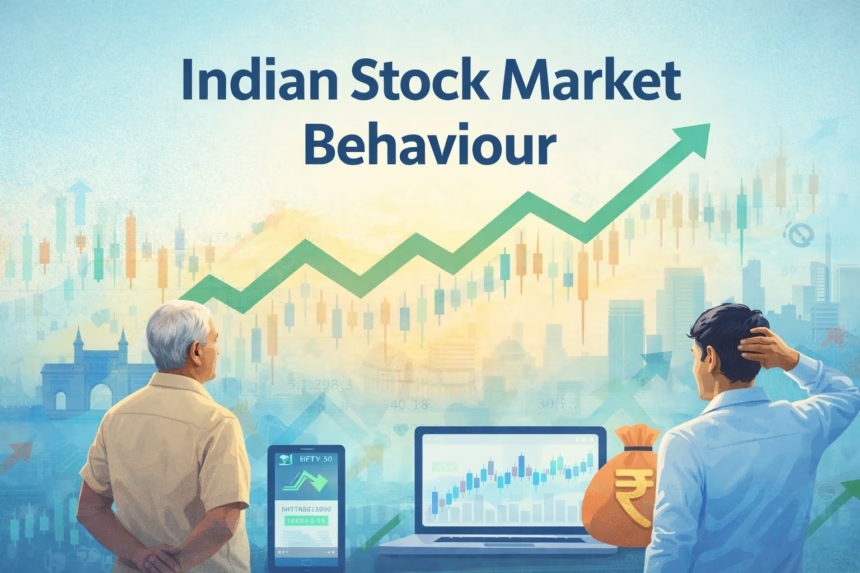
This long-term pattern is a reminder of how Indian Stock Market Behaviour unfolds quietly over years, not days
This page exists to explain that feeling. Not through predictions. Not through numbers. But through behaviour — how markets actually move, why they pause, and what they silently reward over time.
If you understand Indian Stock Market Behaviour, you stop reacting. And when reactions stop, wealth quietly starts working.
Why the Indian Stock Market Behaviour Feels Confusing
The market feels confusing because it rarely behaves the way we expect it to.
Good news comes, and prices do not move. Bad news comes, and the market refuses to fall. Results are announced, budgets are passed, elections happen, yet the screen looks almost unchanged.
This creates a gap between expectation and experience.
Most investors believe markets should go up when news is good, fall when news is bad, and reward effort and attention. But markets do not work on fairness or logic. They work on collective human behaviour.
By the time news becomes obvious, it is usually already priced in. What moves markets is not information. It is surprise. When there is no surprise, markets rest.
The Market Is Not a Machine, It Is Human
The Indian stock market is often spoken about like a machine. Inputs, outputs, triggers, reactions. In reality, it is a crowd.
Every price reflects fear of loss, hope of gain, regret of missing out, and boredom of waiting.
When fear dominates, prices fall faster than logic. When greed dominates, prices rise beyond comfort. When boredom dominates, prices do nothing.
Most long-term wealth is created not during excitement, but during boring phases when nothing feels rewarding.
Markets do not test intelligence. They test emotional stability.
Why Markets Go Sideways for Long Periods
Sideways markets are not broken markets. They are resting markets.
There are two ways markets adjust. Price correction through sharp falls, and time correction through long pauses. Indian markets often choose time correction.
Prices remain within a range while businesses grow slowly, excess optimism cools down, and valuations become reasonable again.
For investors, this phase feels pointless. For markets, it is necessary.
Sideways phases quietly separate those who are invested for reasons from those who are invested for excitement.
Understanding Indian Stock Market Behaviour is less about prediction and more about patience.
Why Most Investors Feel Late
Almost every investor feels late. Late to enter, late to benefit, late compared to someone else.
This feeling comes from comparison, not reality.
Someone always bought earlier. Someone always made more. Someone always seems smarter.
But markets do not reward being first. They reward staying long enough.
Most wealth stories are not about perfect timing. They are about imperfect investors who stayed invested when nothing was happening.
Volatility Is Normal, Panic Is Optional
Price movement is not damage.
A falling market is not a personal failure. A volatile month is not a warning sign.
Volatility is simply the market breathing.
Panic begins when portfolios are checked too often, short-term movement is treated as long-term truth, and noise replaces understanding.
For market education and transparency, investors can also refer to the
National Stock Exchange of India
and insights shared by the
Reserve Bank of India.
What Long-Term Market Behaviour Rewards
Over time, the Indian stock market has rewarded consistency over intensity, discipline over brilliance, and patience over prediction.
Doing nothing often feels irresponsible. In reality, unnecessary action is the bigger risk.
Markets reward investors who continue their SIPs quietly, avoid reacting to headlines, and let time do the heavy lifting.
The reward does not come immediately. It comes eventually. And usually without drama.
This is the quiet lesson of Indian Stock Market Behaviour over time.
Common Behavioural Mistakes Investors Make
Most losses do not come from market crashes. They come from behaviour during normal times.
- Acting because others are acting
- Exiting because returns feel slow
- Entering because prices already ran up
- Confusing activity with progress
The market does not punish ignorance. It punishes impatience.
Frequently Asked Questions
Is it normal if the market does not move for years?
Yes. Sideways phases are part of healthy market cycles. They often prepare the ground for future growth.
Should SIPs be stopped when the market feels uncertain?
Uncertainty is when discipline matters most. SIPs are designed to work through uncertainty, not avoid it.
Why do markets fall without warning?
Markets react to surprise, not visible information. When everyone expects something, it stops being a trigger.
A Calm Closing Thought
The Indian stock market does not reward urgency. It rewards understanding.
Once you accept that markets move in phases of excitement, fear, boredom, and recovery, your reactions soften.
You stop checking every day. You stop feeling late. You stop needing answers for every movement.
And slowly, quietly, the market starts working with you instead of against you.
If the market feels boring right now, you are probably doing something right.
Last reviewed: January 2026
For readers looking to understand long-term discipline better, our guide on
mutual funds and SIP investing explains how patience works in real life.